How to check if ChatGPT recommends your product
Key takeaways
- Ask buyer questions, not your brand name. A question that names your product only tests whether ChatGPT recognises you, not whether it would recommend you to a stranger.
- Use a fresh temporary chat, and ask each question at least 10 times. ChatGPT writes a new answer every time, so one answer tells you almost nothing.
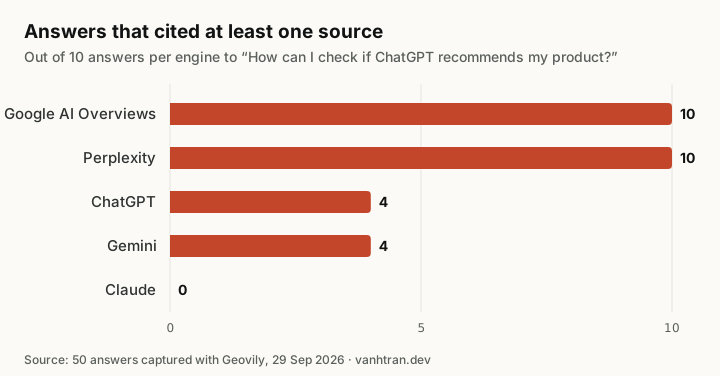
- Test all five AI engines, because they behave differently. In my 50-run test, Perplexity cited sources in 10 of 10 answers, ChatGPT in 4 and Claude in none.
- Log who is named, where, and which sources are cited. The pages cited next to your competitors show you where to be listed.
- Check once a week. AI answers change fast, and a weekly check catches a gain or a drop while you can still act on it.
To see what AI engines say about this today, I asked one exact question, "How can I check if ChatGPT recommends my product?", 10 times each on ChatGPT, Perplexity, Gemini, Claude and Google AI Overviews on 29 September 2026. I saved all 50 answers and every source they cited. Perplexity cited the same pages in almost every run. ChatGPT cited only OpenAI's own help pages, and only in four runs.
This post is also an experiment. I want to find out whether a firsthand article can get cited when AI engines answer that exact question. I'll run the same 50 checks again once this post is indexed and report what changed.
Below are the method, what the 50 answers showed, and how to read your own results.
How do you check if ChatGPT recommends your product?
To check if ChatGPT recommends your product, ask it the questions your buyers ask, without your product's name, in a fresh temporary chat. Ask each question at least 10 times, then repeat the test in Perplexity, Gemini, Claude and Google AI Overviews. Record whether you're named, where you rank, and which sources get cited. One answer tells you almost nothing. A pattern across repeated answers tells you where you stand.
1. Write the questions your buyers ask, without your product's name
A question that names your product only tests whether ChatGPT recognises you. It doesn't test whether ChatGPT would recommend you to a buyer who has never heard of you.
Write 5 to 10 questions a buyer would type before they know you exist. Take them from sales calls, support tickets and the words customers use in demos. "What's the best help desk for a five-person support team?" is a buyer question. "Is [your product] good?" is not.
2. Open a fresh temporary chat
ChatGPT's memory and past conversations change its answers. If you've discussed your product with ChatGPT before, it may mention you because it remembers you, not because a stranger would see you.
Use ChatGPT's temporary chat, a logged-out window, or an account with memory turned off.
3. Ask each question at least 10 times
ChatGPT writes a new answer every time, so the products it names change from run to run. Ask each question at least 10 times, each in a new chat, and count how many answers name you. In my test, ChatGPT cited sources in 4 of 10 answers to the same question. With only a few runs, a pattern like that is easy to miss.
"Named in 6 of 10 answers" is a result you can track. "It mentioned us once" is not.
4. Run the same questions on other AI engines
Each AI engine reads different sources and behaves differently. In my test, Perplexity cited sources in all 10 answers, ChatGPT in 4, and Claude in none. Run your questions on ChatGPT, Perplexity, Gemini, Claude and Google AI Overviews, because a buyer can use any of them.
5. Log who is named, where, and which sources are cited
For every answer, record whether you're named, your position in the list, which competitors are named, and which pages the answer cites. The cited pages are the most useful column. When an AI engine recommends a competitor, the pages it cites show you where that recommendation comes from.
What happened when I ran this check 50 times?
I asked "How can I check if ChatGPT recommends my product?" 10 times on each of five AI engines on 29 September 2026, each time in a new chat. Geovily captured every full answer and every cited link.
| Engine | Answers that cited sources | Sources per answer | Different links cited | Most-cited page |
|---|---|---|---|---|
| ChatGPT | 4 of 10 | 0.7 | 3 | An OpenAI help article (4 of 10) |
| Perplexity | 10 of 10 | 10.5 | 23 | stork.ai (10 of 10) |
| Gemini | 4 of 10 | 1.7 | 7 | le-artist.cz (4 of 10) |
| Claude | 0 of 10 | 0 | 0 | none |
| Google AI Overviews | 10 of 10 | 7.8 | 40 | le-artist.cz (8 of 10) |
Six things stood out:
- Perplexity was the most predictable engine. Ten pages appeared in at least 8 of Perplexity's 10 answers. If you want to know what Perplexity will cite tomorrow, today's answer is a good guide.
- Google AI Overviews cited the widest range of sources. Its 10 answers cited 40 different links, and only one, an article from le-artist.cz, appeared in 8 or more of them. YouTube videos appeared in 9 of the 10 answers, but no single video appeared in more than 5.
- ChatGPT cited sources in only 4 of 10 answers, and every source was an OpenAI help page. No third-party article on this topic made it into a ChatGPT answer. For this question, ChatGPT is the most open engine to a new source.
- Claude never searched the web for this question, so it cited nothing. I confirmed this by hand in a claude.ai incognito chat. Claude answered from what it already knew.
- The most-cited article overall was 8 days old. le-artist.cz published its guide on 21 September 2026. By 29 September, Gemini and Google AI Overviews cited it in 12 of their 20 answers.
- No page was cited by more than two of the five engines. The only overlaps were three pages shared by Gemini and Google AI Overviews, which are both Google products. Being cited by one engine says little about the others.
Is being mentioned the same as being cited or recommended?
No. A mention, a citation and a recommendation are three different results, and an AI visibility check should record them separately.
| Result | What it means | Example |
|---|---|---|
| Mention | The answer names your product. | Claude named the AI visibility tool Profound in 8 of its 10 answers, without citing any page. |
| Citation | The answer links to your page as a source. | Perplexity cited searchable.com in 9 of its 10 answers. |
| Recommendation | The answer tells the reader to choose your product for their situation. | "For a five-person team, use [product], because…" |
A citation count tells you what an AI engine read. It doesn't tell you what the engine used, or what it told the buyer to do.
Why does ChatGPT give a different answer every time?
ChatGPT composes each answer fresh. The result depends on the exact wording, whether ChatGPT decides to search the web, which pages the search returns at that moment, the account's memory, and some built-in randomness.
Search is the biggest switch. In my test, ChatGPT cited web sources in 4 of 10 answers to the same question and cited nothing in the other 6. The two kinds of answer can name different products. That's why a single check misleads in both directions: one lucky mention makes an invisible product look visible, and one miss makes a well-covered product look invisible.
Report your result as a rate, such as "named in 6 of 10 answers", and compare rates over time.
Which questions should a SaaS founder test?
Test the questions a buyer asks at each stage of choosing software. Here is a starter set for an imaginary help desk product:
| Question type | Example |
|---|---|
| Category | "What's the best help desk software for a five-person support team?" |
| Alternatives | "What are good alternatives to Zendesk for a small startup?" |
| Problem | "How do I stop support emails getting lost in a shared inbox?" |
| Integration | "Which help desk tools work with Slack and HubSpot?" |
| Price or constraint | "What's the best help desk under $20 per agent per month?" |
| Branded (a separate check) | "What is [your product] and who is it for?" |
The first five are the real test, because they show whether you appear before a buyer knows your name. The branded question checks something else: whether AI engines describe your product correctly once a buyer does know it.
What should you record in a tracking sheet?
Record one row per answer. These columns are enough. The row below is an example for the imaginary help desk, not real data:
| Date | Engine | Question | Run | Named? | Position | Competitors named | Sources cited |
|---|---|---|---|---|---|---|---|
| 29 Sep 2026 | ChatGPT | Best help desk for a five-person team? | 3 of 10 | Yes | 4th | Zendesk, Help Scout, Freshdesk | g2.com, a Reddit thread |
From the sheet, work out one number per question and engine: your mention rate, the share of answers that name you. Then look down the "Sources cited" column. The pages that keep appearing next to your competitors are the pages you most need to be on.
What should you do if ChatGPT doesn't name you?
Start with the sources, not with your own website. The pages that AI engines cite for your competitors show what the engines trust in your category.
- Open every page cited next to a competitor. Note whether each is a review site, a "best tools" roundup, a community thread or the competitor's own page.
- Say plainly on your site what your product does, for whom and at what price. An AI engine can only repeat what someone has written clearly.
- Earn a place on the pages the engines already cite. Complete your review-site profiles and ask to be considered for honest roundups.
- Use the same product name and description everywhere. Conflicting descriptions make it harder for an engine to be sure what you are.
- Re-run the same questions once a week. AI answers change fast, and a weekly check shows a gain or a drop while you can still act on it.
What mistakes make the check useless?
- Asking only about your own brand. A correct answer to "What is [your product]?" says nothing about whether buyers see you.
- Trusting one answer. A single answer is a sample of one.
- Testing in your everyday account. Memory and past chats can put your product into answers a stranger wouldn't get.
- Counting citations as recommendations. Being linked as a source is not the same as being named as the answer.
- Testing only ChatGPT. In my test, the five engines shared almost no sources.
- Changing the wording between checks. Keep each question word for word, or the comparison breaks.
Should you use a tool or check by hand?
Check by hand first. Running 5 questions, 10 times each, on one engine shows you what your buyers see and which sources matter in your category.
A tool becomes worth paying for when you track many questions across several engines every week. The tools named most often in my 50 answers were Profound (15 answers), Semrush (14), Peec AI (13) and Otterly (13).
How I ran this test
- Question: "How can I check if ChatGPT recommends my product?", word for word, every time.
- Date: 29 September 2026.
- Engines: ChatGPT (default mode, extended thinking off), Perplexity, Gemini, Claude (Sonnet) and Google AI Overviews.
- Runs: 10 new chats per engine, 50 answers in total. ChatGPT, Perplexity, Gemini and Claude ran on several logged-in accounts in rotation, in new chats rather than temporary chats. Google AI Overviews came from a plain Google search.
- Captured: the full answer and every cited link, using Geovily.
- Limits: One question on one day is a pilot, not a law about AI answers. Answers can differ by country, account and date.
This post is part of the test. I'll ask the same question again after the post is indexed, then 3 and 14 days later, and report in the Build Log whether any engine cites it.
Frequently asked questions
How many times should I ask ChatGPT each question?
Ask each question at least 10 times, each in a new chat. ChatGPT writes a new answer every time, so the products it names change between runs. Ten runs are enough to see whether a product is named consistently or only by chance.
Does ChatGPT give everyone the same answer?
No. ChatGPT's answer depends on the exact wording, whether it searches the web, the pages its search finds at that moment, and the user's memory and past chats. Two people asking the same question can see different products.
Does web search change which products ChatGPT recommends?
Yes. When ChatGPT searches the web, it builds its answer from the pages it finds and can cite them. Without search, ChatGPT answers from what it learned in training. In a 10-run test on 29 September 2026, ChatGPT cited web sources in 4 of 10 answers to the same question.
How often should I check whether ChatGPT recommends my product?
Check once a week. AI answers change fast, so a weekly check shows a gain or a drop while you can still act on it. Use the same questions, the same engines and the same number of runs each time, so the results can be compared.
Why does ChatGPT recommend my competitor instead of me?
ChatGPT tends to name the products that appear in the sources it reads, such as review sites, "best tools" roundups and community threads. If your competitor is on those pages and you're not, the competitor is more likely to be named. The sources cited in ChatGPT's answer show which pages to look at first.